Publishing Pros & Cons (Traditional vs. Self-Publishing)
I wrote The Words I Didn't Listen To and IKIGAI: Love Is Not Enough, Nor Is It the Answer from stories I needed to tell. I wanted the books, my thoughts, my words in people's hands. So I found out I could do it myself, figured out how to do it myself, and I did it myself—the writing, the editing, the design, the formatting, the distribution. All of ‘em.
I didn't deeply research traditional publishing before I chose self-publishing. I was moving fast, operating on instinct, and building from what I knew. What I've learned since is that both paths are legitimate — and both have real trade-offs worth understanding before you decide.
Here’s how to decide:
How Traditional Publishing Works
Most people picture traditional publishing as submitting a manuscript and waiting for a yes. There are a few more steps in between.
It starts with finding a literary agent — someone who represents your book to publishers, negotiates your contract, and advocates for your career. You don't go directly to a publisher. You query agents first, and top agents receive over 1,500 query letters a month. Most requests take four to eight weeks for a response. Many never come at all.
J.K. Rowling's first Harry Potter novel was rejected by 12 publishers before a small independent press called Bloomsbury took a chance on her—and only because the chairman's eight-year-old daughter demanded to read the rest of the manuscript. Bloomsbury printed just 500 copies initially and advised Rowling to keep her day job. That's traditional publishing sometimes: good gatekeepers, good luck, and good timing.
Your platform matters too. If an agent gets queries from two authors who've written books in the same genre and both projects are strong, but one author has a significant social media following and the other doesn't, the agent is more likely to choose the one with the platform. You don't have to be famous to get a deal—great writing and a strong query letter still open doors—but a built-in audience helps, especially for nonfiction.
Once you have an agent and they secure a deal, the publisher covers editing, cover design, printing, and distribution. You may receive an advance (typically $5,000–$15,000 for a first-time author) before the book goes on sale. The publisher handles the infrastructure. You trade control for support.
The trade-offs: royalties are typically 7.5% on paperback sales, and roughly 75% of traditionally published authors never earn out their advance, meaning the advance is all the money they ever see from that book. The publisher also makes final calls on your cover, title, pricing, and release date. And the timeline from signed contract to book on shelves is typically one to two years, sometimes longer.
Some extra good news is: the publishing landscape has expanded. Alongside the Big Five, hundreds of smaller independent publishers have emerged in recent years, many focused on niche audiences, underrepresented voices, and categories the traditional market has historically overlooked. They often move faster, offer more creative collaboration, and take risks the big houses won't. They may be a great place to start if you choose to traditionally publish! It’s like going to the best CUNY for your major when you know EXACTLY what you want to be when you grow up—smart move.
How Self-Publishing Works
Self-publishing means you own everything — the rights, the decisions, the timeline, and the revenue. You write it, you publish it, you sell it. You either do the production work yourself or hire people to help, but either way, you're in charge.
Platforms like Amazon KDP (which I’ve published through) offer royalty rates of around 70% for ebooks and about 60% for print books after printing costs, compared to traditional publishing's 7.5–15%. Self-published authors captured 51% of overall ebook unit sales and generated over $874 million in ebook revenue in 2022. The stigma is gone. The market has spoken.
You can publish in weeks instead of years. You keep your rights. You can update the book whenever you want—I redesigned my covers ten years in, and no one had to approve that. No one got a cut of the decision.
However,
You fund everything. A professional editor, cover designer, formatter, and marketing plan add up. There's no advance to cushion that. You're investing in your own book before it earns a cent.
You handle marketing. Some traditional publishers do meaningful marketing. Many don't; they'll put your book in the catalog and expect you to drive the audience. But even when they don't, their name opens doors you'd have to knock on yourself.
You build everything from scratch. Distribution, reviews, retail placement—all of that takes work and time. Self-publishing doesn't come with a built-in audience or a publicist.
Self-Publishing vs. Traditional Publishing: A Quick Comparison
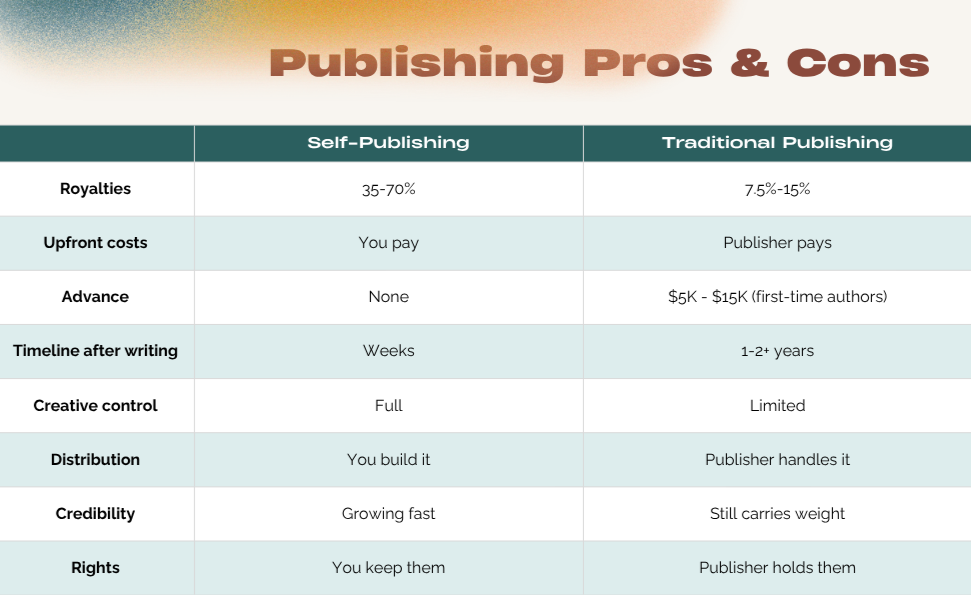
You can also find a personality and budget-based list here.
Which Path Is Right for You?
Traditional publishing makes sense if you're writing in a category with wide commercial appeal, you want institutional credibility, you're willing to play the long game, and you can release creative control without resentment.
Self-publishing makes sense if you have a message that needs to get out, you want to own your work and your revenue, you're willing to invest in the process, and you trust yourself to execute or build the right team.
I self-published because my stories weren't waiting for permission. That was the right call for me. But I could also see myself traditionally publishing one day, and getting great joy out of that!
What doesn't work is doing nothing because you can't decide.
The book you've been waiting to write deserves to be read!
Whether you're self-publishing and need help with developmental editing, book coaching, or author platform development — or you're still figuring out your next steps — I'd love to help. Let's talk.