Writing Dominique Middleton Writing Dominique Middleton

What Is Developmental Editing — And Do You Need It?

Most people think editing means someone fixes your grammar. It doesn't. That's proofreading. That's the last step. And if you're doing it first, you're decorating a house that hasn't been built yet. Developmental editing is the step most authors skip — because they didn't know it existed, or because they convinced themselves their manuscript was done. (It's probably not done.)...
Most people think editing means someone fixes your grammar. It doesn't. That's proofreading. That's the last step. And if you're doing it first, you're decorating a house that hasn't been built yet.

Developmental editing is the first step (well, that's after writing of course!). This is the editing most authors skip because they didn't know it existed, or because they convinced themselves their manuscript was done. (It's probably not done. ) Here's what it is, what it isn't, and how to know whether you need it before you publish something you'll wish you'd done differently.

What Is Developmental Editing?

Developmental editing looks at your book from the top down. Before anyone touches a sentence, a developmental editor reads your entire manuscript and evaluates the big picture—the structure, the flow, the clarity of your message, the consistency of your voice, and whether your reader can follow the journey you're trying to take them on. Not whether your sentences are pretty. Whether your book works.

A developmental editor is asking: Does this book have a clear premise? Who is the reader? (That's a strategic/marketing question!) Is the reader's journey logical—or are you assuming they can read your mind? Does your voice hold throughout, or does it drift? Is there content that's missing, repeated, or out of place? Does your reader know this book is for them—and do they see themselves in it? These aren't editorial suggestions. They're structural ones. And structure is what separates a manuscript from a book.

What Developmental Editing Is Not

It is not copyediting; that's grammar, punctuation, and syntax. It is not proofreading; that's catching errors before print. Both matter, but not until after the book makes sense. It's also not a rewrite. A good developmental editor doesn't replace your voice. They help you find it, and then hold it consistently so the person who meets you on page one is still with them on the last page.

What Developmental Editing Looks Like in Practice

I worked with an author named Renise on a manuscript she described as a collection of prayers. It was personal. It was meaningful. And it wasn't working yet. Of course, her prayers were powerful; we didn't change a single one...but because the reader had no road map. She'd written something beautiful. She just hadn't written something navigable.

After developmental editing, the book became something different and something more. It now has a clear structure: a dedication, an introduction, three organized prayer sections—Prayers of Faith, Prayers of the Mind, Prayers of the Heart—and a closing reflection. Each section opens with Renise's personal story so readers understand why these prayers exist and how they connect to her healing, her identity, and her faith journey. Before, the prayers were grouped. Now they build on each other.

We widened the audience so women in different life seasons—not just mothers or wives—could see themselves in the book. I clarified the reader journey so someone picking it up knows whether to read straight through or turn to what they need in the moment. I called for scripture references throughout, so the devotional felt more grounded. I flagged repeated ideas and consolidated them. We defined her voice as hopeful, honest, faith-filled, and guiding and made sure it held true from the first prayer to the last. The title changed. The subtitle changed. The positioning changed. Same prayers. Entirely different book. That's what developmental editing does. It doesn't change what you said. It clarifies what you meant.

Signs You Need Developmental Editing Before You Publish

Let me be direct with you (because when am I not): If you've finished your manuscript and something feels off but you can't figure out exactly what, that's the sign. If you've had people read it and the feedback is vague ("It's good," "I liked it," nothing specific), that's the sign. If your chapters feel disconnected or your content keeps circling back to the same ideas, that's the sign. If you're not sure who your reader is, or whether your book is speaking to them, that's the sign. And if you're planning to pursue traditional publishing? Your manuscript needs to be competitive before it gets in front of an agent. Developmental editing is how you get there.

Self-publishing doesn't get you off the hook either. Readers can tell. They may not be able to know what's missing, but they feel it. And they don't finish the book. You may not need developmental editing yet if your manuscript is still in early draft form. Get the ideas out first. Developmental editing works best on a complete draft, even a messy one. It needs to see the whole thing.

What Happens After Developmental Editing

You get a detailed editorial letter: a document that outlines what's working, what isn't, and specific recommendations for revision. You take that feedback and revise. After revision (or two or three) comes line editing, then copyediting, then proofreading. Each step assumes the previous one is done.

Skipping developmental editing and going straight to copyediting is like asking someone to polish the windows before you've decided where the walls go.

The Thing Nobody Tells First-Time Authors

Your manuscript being unedited doesn't mean it's bad. It means it's not done. Every book you've ever loved went through this process—the ones that changed your life, the ones dog-eared on your nightstand, and the ones you bought for every person you know. They all had someone look at the big picture before anyone looked at the sentences.

You wrote something worth finishing.

Finish it right.

Ready to find out what your manuscript needs? Let's talk.

Read More
Writing Dominique Middleton Writing Dominique Middleton

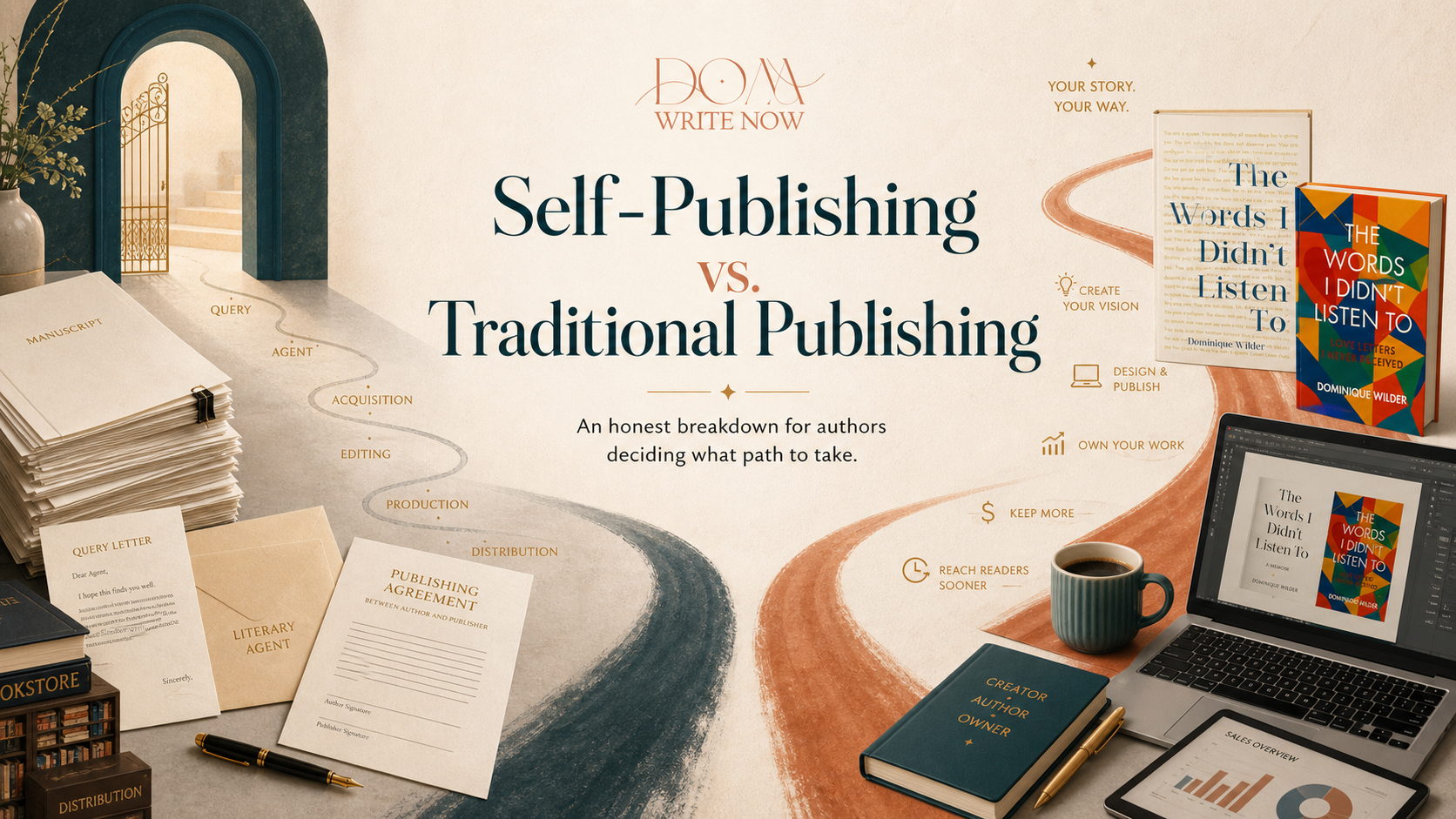
Publishing Pros & Cons (Traditional vs. Self-Publishing)

I wrote The Words I Didn't Listen To and IKIGAI: Love Is Not Enough, Nor Is It the Answer from stories I needed to tell. I wanted the books, my thoughts, my words in people's hands. So I found out I could do it myself, figured out how to do it myself, and I did it myself. Full transparency: I didn't deeply research traditional publishing before I chose self-publishing. What I've learned since is that both paths are legitimate — and both have real trade-offs worth understanding before you decide...
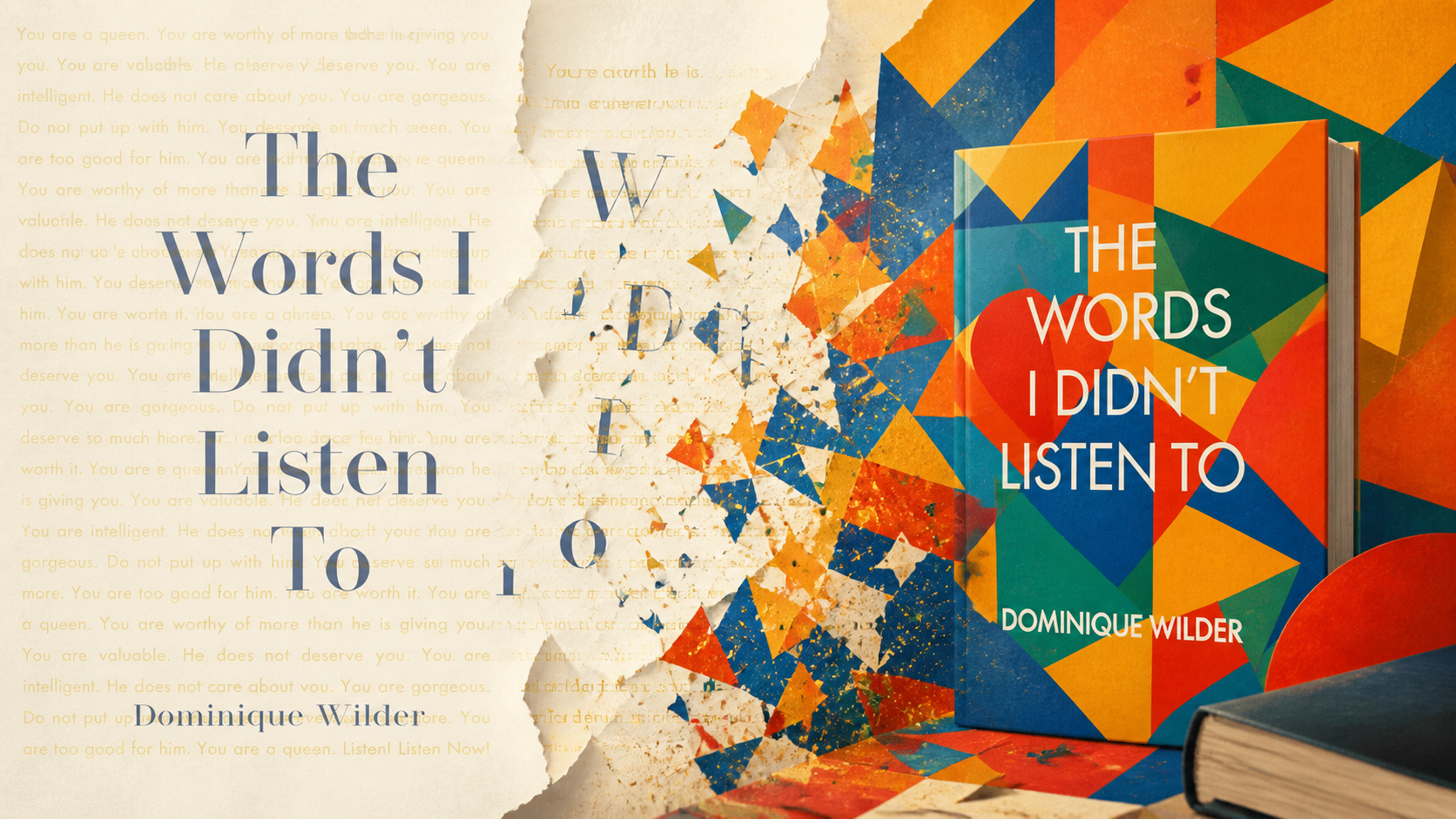
I wrote The Words I Didn't Listen To and IKIGAI: Love Is Not Enough, Nor Is It the Answer from stories I needed to tell. I wanted the books, my thoughts, my words in people's hands. So I found out I could do it myself, figured out how to do it myself, and I did it myself—the writing, the editing, the design, the formatting, the distribution. All of ‘em.

I didn't deeply research traditional publishing before I chose self-publishing. I was moving fast, operating on instinct, and building from what I knew. What I've learned since is that both paths are legitimate — and both have real trade-offs worth understanding before you decide.

Here’s how to decide:

How Traditional Publishing Works

Most people picture traditional publishing as submitting a manuscript and waiting for a yes. There are a few more steps in between.

It starts with finding a literary agent — someone who represents your book to publishers, negotiates your contract, and advocates for your career. You don't go directly to a publisher. You query agents first, and top agents receive over 1,500 query letters a month. Most requests take four to eight weeks for a response. Many never come at all.

J.K. Rowling's first Harry Potter novel was rejected by 12 publishers before a small independent press called Bloomsbury took a chance on her—and only because the chairman's eight-year-old daughter demanded to read the rest of the manuscript. Bloomsbury printed just 500 copies initially and advised Rowling to keep her day job. That's traditional publishing sometimes: good gatekeepers, good luck, and good timing.

Your platform matters too. If an agent gets queries from two authors who've written books in the same genre and both projects are strong, but one author has a significant social media following and the other doesn't, the agent is more likely to choose the one with the platform. You don't have to be famous to get a deal—great writing and a strong query letter still open doors—but a built-in audience helps, especially for nonfiction.

Once you have an agent and they secure a deal, the publisher covers editing, cover design, printing, and distribution. You may receive an advance (typically $5,000–$15,000 for a first-time author) before the book goes on sale. The publisher handles the infrastructure. You trade control for support.

The trade-offs: royalties are typically 7.5% on paperback sales, and roughly 75% of traditionally published authors never earn out their advance, meaning the advance is all the money they ever see from that book. The publisher also makes final calls on your cover, title, pricing, and release date. And the timeline from signed contract to book on shelves is typically one to two years, sometimes longer.

Some extra good news is: the publishing landscape has expanded. Alongside the Big Five, hundreds of smaller independent publishers have emerged in recent years, many focused on niche audiences, underrepresented voices, and categories the traditional market has historically overlooked. They often move faster, offer more creative collaboration, and take risks the big houses won't. They may be a great place to start if you choose to traditionally publish! It’s like going to the best CUNY for your major when you know EXACTLY what you want to be when you grow up—smart move.

How Self-Publishing Works

Self-publishing means you own everything — the rights, the decisions, the timeline, and the revenue. You write it, you publish it, you sell it. You either do the production work yourself or hire people to help, but either way, you're in charge.

Platforms like Amazon KDP (which I’ve published through) offer royalty rates of around 70% for ebooks and about 60% for print books after printing costs, compared to traditional publishing's 7.5–15%. Self-published authors captured 51% of overall ebook unit sales and generated over $874 million in ebook revenue in 2022. The stigma is gone. The market has spoken.

You can publish in weeks instead of years. You keep your rights. You can update the book whenever you want—I redesigned my covers ten years in, and no one had to approve that. No one got a cut of the decision.

However,

You fund everything. A professional editor, cover designer, formatter, and marketing plan add up. There's no advance to cushion that. You're investing in your own book before it earns a cent.

You handle marketing. Some traditional publishers do meaningful marketing. Many don't; they'll put your book in the catalog and expect you to drive the audience. But even when they don't, their name opens doors you'd have to knock on yourself.

You build everything from scratch. Distribution, reviews, retail placement—all of that takes work and time. Self-publishing doesn't come with a built-in audience or a publicist.

Self-Publishing vs. Traditional Publishing: A Quick Comparison

You can also find a personality and budget-based list here.

Which Path Is Right for You?

Traditional publishing makes sense if you're writing in a category with wide commercial appeal, you want institutional credibility, you're willing to play the long game, and you can release creative control without resentment.

Self-publishing makes sense if you have a message that needs to get out, you want to own your work and your revenue, you're willing to invest in the process, and you trust yourself to execute or build the right team.

I self-published because my stories weren't waiting for permission. That was the right call for me. But I could also see myself traditionally publishing one day, and getting great joy out of that!

What doesn't work is doing nothing because you can't decide.

The book you've been waiting to write deserves to be read!

Whether you're self-publishing and need help with developmental editing, book coaching, or author platform development — or you're still figuring out your next steps — I'd love to help. Let's talk.

Read More
Writing Dominique Middleton Writing Dominique Middleton

We Listen. And We Judge Books by the Cover.

I am a four-time author. My first two books — The Words I Didn't Listen To and IKIGAI: Love Is Not Enough, Nor Is It the Answer — I wrote, formatted, designed, and published myself. No publishing house. No budget. Just me, a laptop, and a deadline I gave myself. And I was proud of them. I still am. But the covers? When I look back at what I launched with, I know I could have done better...
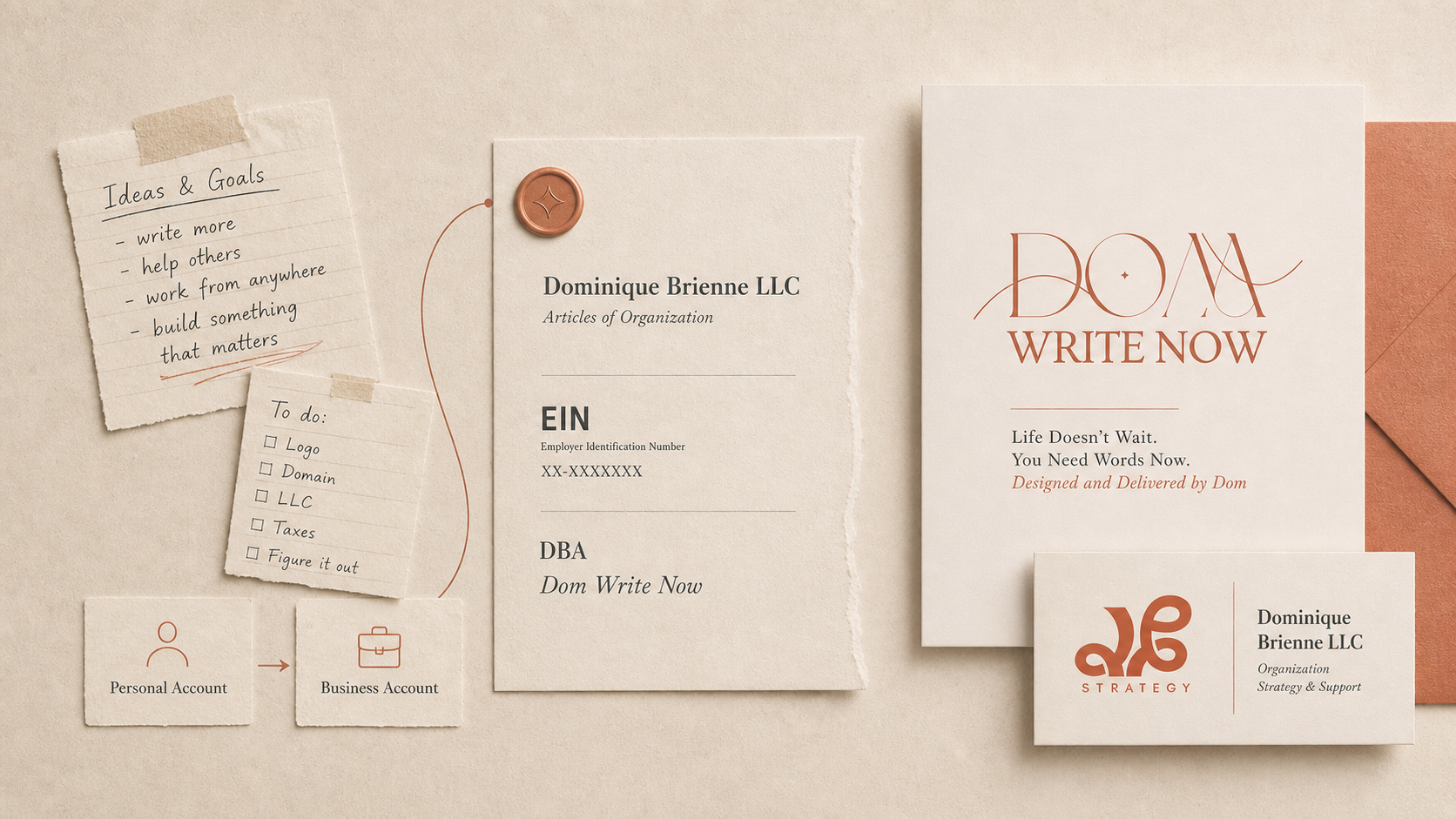
I am a four-time author. My first two books — The Words I Didn't Listen To and IKIGAI: Love Is Not Enough, Nor Is It the Answer — I wrote, formatted, designed, and published myself. No publishing house. No budget. Just me, a laptop, and a deadline I gave myself.

And I was proud of them. I still am.

But the covers? When I look back at what I launched with, I know I could have done better. I was just trying to get the thing out. The message inside was right. The cover was an afterthought.

That cost me. My book covers felt like the ones people would scroll past, put down, and not pick back up. They felt like…book covers, and not art. Art gets revisited, talked about, shared, and is loved!

Ten years later, I redesigned them. I want to save you from this mistake.

We Say We Don't Judge Book Covers. We Do.

Let's be honest. The phrase "don't judge a book by its cover" exists because we constantly do it.

According to a 2023 survey of 2,000 adults conducted by OnePoll on behalf of ThriftBooks, 57% of Americans have bought or read a book based solely on its cover. And 80% have avoided a book because of its outward appearance: because the cover looked too plain, used a font they didn't like, or featured art that didn't match the genre.

That's not shallow. That's human. Your brain processes images faster than words. A cover makes you feel something before you read a single sentence. That feeling is a bit of a promise—maybe "this is for you" or "this isn't."

When my covers weren't doing their job, they weren't making that promise.

What a Book Cover Actually Communicates

A book cover isn't decoration. It's your first sentence.

It tells a reader what kind of story this is, whether they can trust the person who made it, and whether the content inside will honor their time. When my original covers didn't say that — when they said self-published, first draft, figuring it out — readers heard it. Even if they couldn't articulate why.

Redesigning them ten years in wasn't about shame. I actually still love my original covers. In full transparency, I love the original cover of The Words I Didn’t Listen To MUCH more than I like the original of IKIGAI. But both deserved more effort than what I gave them the first time around. The message outside finally matched what was being communicated on the inside.

A cover is your first point of sale. And research shows that redesigning a cover well can lead to increased sales! Don’t wait until there are potentially low sales to think about your first impression.

How to Get Your Book Cover Right the First Time

Here's what I learned the hard way.

1. Hire a professional book cover designer. Not a general graphic designer.

There's a difference. A great graphic designer can make something beautiful. But a book cover designer understands genre signals, thumbnail readability, spine layout, back cover hierarchy, and what makes a cover work at 200 pixels on an Amazon listing. Those are specific skills. You want someone who has them.

I actually did hire someone the second time around, before I went and designed them myself. And I hated my options.

Not because the designer was bad at design—but because I hadn't done the work of knowing what I wanted before I handed off the project and that the skills between a cover designer and graphic designer are different. So I got options that were technically fine and completely wrong for the book.

That's on me—and it's a mistake I see authors make constantly.

2. Study the covers that are already selling.

Before you brief anyone (and your designer should ask you for a brief!), spend time on Amazon in your genre. Look at the bestseller lists, not to copy, but to understand the visual language readers already associate with that kind of story. What fonts are showing up? What color palettes? What imagery? You're joining a conversation, and your cover needs to speak the right language while still standing out.

3. Build a reference folder before the first conversation.

Pull 10–15 covers you love and 5–10 you want nothing to do with. For each one, be able to say why. This is the homework that makes a designer's job possible and your outcome predictable. Without it, you're asking someone to read your mind—and that's not fair to either of you.

4. Ask for a designer's portfolio of books that have actually sold.

Anyone can show you a beautiful mockup. What you want to see is: have the covers this person designed shown up in the market? Do they understand how a cover functions in the real world — not just how it looks in a portfolio? Ask specifically about their experience with your genre. Ask what's performing.

5. Be prepared to give real feedback.

"I don't love it" is not feedback. "The title font feels too light for a memoir — I want something with more weight" is feedback. The more specific you can be about what's working and what isn't, the faster you'll get to something that's actually right.

Book Covers Aren’t Just for Books

This isn't just about books.

Your headshot. Your website. Your Instagram grid. Your logo. Your proposal. All of it is a cover. All of it is making a promise before you say a word.

I help people write and design because I've lived on both sides of this. I know what it feels like to have the right words in the wrong package—and I know the difference it makes when those things align.

The right words at the right time can change everything. That starts with the cover.

Ready to get your words — and your design — right? Let's talk.

Read More
Business Dominique Middleton Business Dominique Middleton

To LLC or…Nothing

I didn't have a mentor who sat me down and walked me through business structures. I didn't take a course. I figured it out the same way I figure out most things: by asking questions until I understood enough to make a decision, then actually making one. But it took me four years before I ever filed anything — four years of doing work, serving clients, and depositing money into a personal account like the whole thing was a hobby. Once I LLC'd, I started taking it seriously. That's not a coincidence...
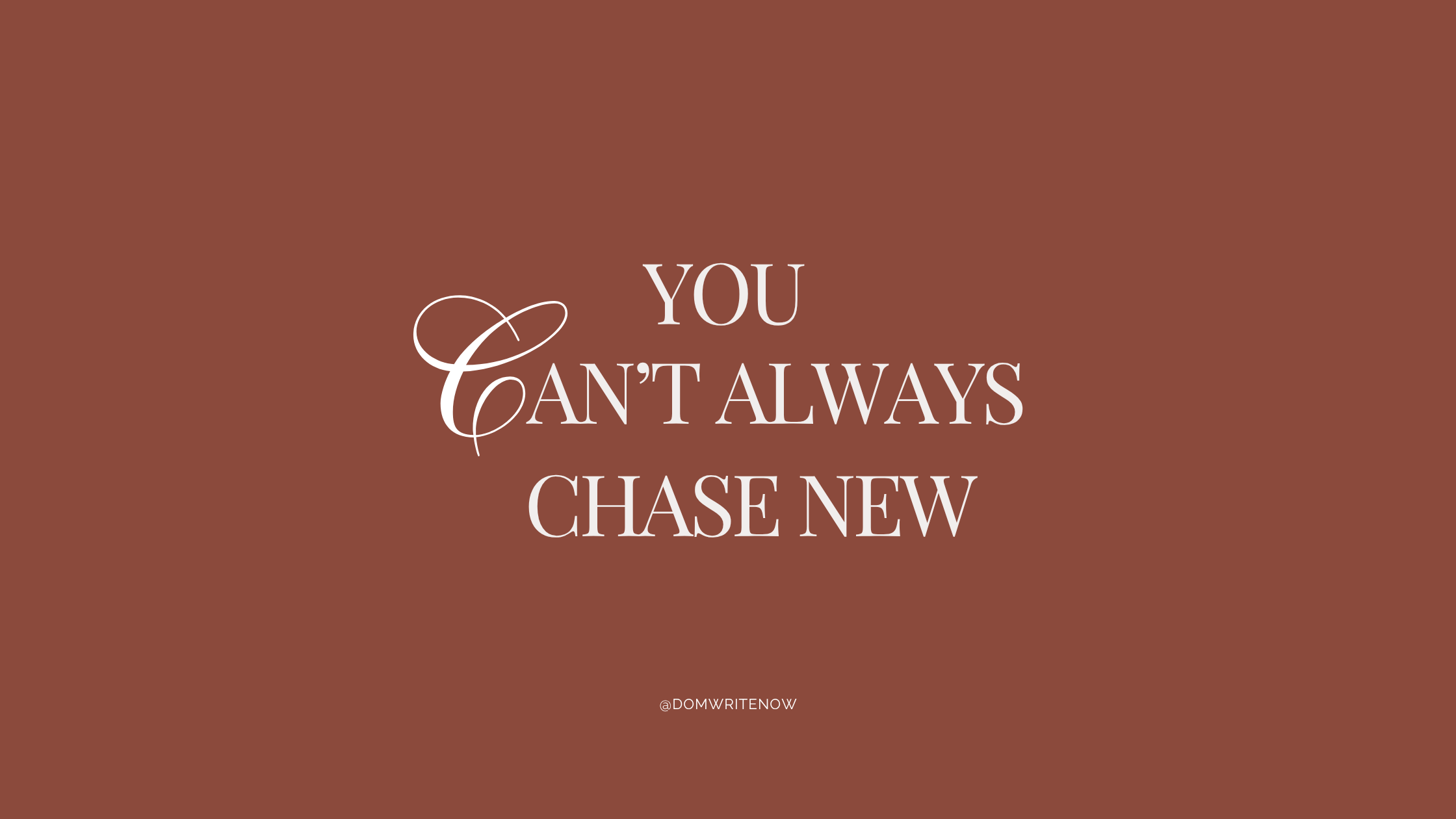
I didn’t have a mentor who sat me down and walked me through business structures. I didn’t take a course. I figured it out the same way I figure out most things: by asking questions until I understood enough to make a decision, then actually making one.

I launched Dominique Brienne LLC. My name. My entity. My legal foundation for everything I build.

But it took me four years before I ever filed anything.

Four years of doing work, serving clients, and depositing money into a personal account. I wasn’t making enough to feel like the paperwork was worth it. But in reality, I also just didn’t know the benefits of the paperwork. And because I hadn’t made it official, I didn’t push myself to make it profitable. The two things were more connected than I realized.

Once I LLC’d, I started taking it seriously. And that’s not a coincidence.

LLC vs. Sole Proprietorship: What’s the Difference?

When you start offering a service or selling something, you don’t automatically have a business structure. You have a sole proprietorship. You didn’t fill out anything. You just… started.

As a sole proprietor, there’s no legal distinction between you and your business. If something goes wrong, ie. a client dispute, a contract disagreement, a lawsuit, they’re not coming after your business. They’re coming after you. Your savings. Your car. Your personal accounts. Everything.

An LLC changes that. It creates a legal separation. Your personal assets sit behind a wall that a creditor or unhappy client would have to work a lot harder to get through.

That alone is worth the paperwork.

What Actually Changes When You Form an LLC

Liability protection gets all the attention. But here’s what else could happen:

You show up differently. Having a legal entity with your name on it — an EIN, a business bank account, a business address that isn’t your home — changes how you carry the thing. It stops feeling like something you’re doing and starts feeling like something you’re running. That shift in identity is underrated.

Clients take you more seriously. When your contract comes from an LLC, when your invoice has a business name on it, when your email isn’t a Gmail — people respond differently. It signals that you’ve invested in this. That signal matters before a single word of your work is read.

You can build credit. As a sole proprietor, your business and personal finances are the same thing. An LLC lets you establish your business as its own financial entity — its own credit, its own history, its own standing with banks and vendors.

You have room to grow. One entity. Multiple brands. I operate Dom Write Now as a DBA — doing business as — under Dominique Brienne LLC. I actually had a different DBA before: “Align,” because everything I do is about helping people get their message, their brand, and their story into alignment with who they are and what they’re doing. I loved the concept, but outgrew the name. I felt it was too generic.

But because the LLC was already in place, changing course didn’t mean starting over legally. I just filed a new DBA. The foundation stayed. The brand evolved…became more aligned. See what I did there?

What Actually Changes When You Form an LLC

You’ll need a few things once you file: a business address that isn’t your home (virtual mailbox services handle this for under $10/month), a separate business bank account (mixing personal and business money can cost you your LLC protection — keep them apart from day one), and an EIN, which is your business’s tax ID. You get it directly from the IRS for free. Don’t pay anyone for it.

In New York specifically, there’s a publication requirement most people don’t know about until it’s almost too late. It’s mandatory, it has a deadline, and skipping it means your LLC isn’t fully compliant. I put the full breakdown — every cost, every step, every deadline — in a free guide I created so you don’t have to figure it out the way I did.

When Should You Form an LLC?

Sooner than I did.

If you’re already working with clients, signing anything, or accepting payment—it’s time. The question isn’t whether you’ll ever need the protection. It’s whether you’ll have it when you do.

You don’t have to have it all figured out. But you do have to make a decision. The LLC doesn’t make you a business owner. The work does. But the LLC protects the work, legitimizes it, and gives you something real to build on.

The “nothing” option isn’t really nothing. It’s risk.

Be safe. Be real. Be about that business, so you can be about that money, honey.

Get the full step-by-step breakdown — every cost, every deadline, every thing I wish I’d known — in the free guide: From Idea to LLC in New York.

Read More