How Writing, Justice, and Preston High School Shaped My Voice as a Woman
I really don’t like to be misunderstood. As an introvert and an adult who hasn’t mastered the art of talking, to be best understood I write. It allows me to express the thoughts I struggle to articulate in conversation.
Even in relationships, when there’s conflict or a thought I can’t fully articulate out loud or something pressing that’s not worth an argument but just important to me, I write it — even if I have to read it later to engage in a convo.
I really am a writer.
When I started writing books and blogs, I did because I had so much to say that I’d never record content for, or go on live to discuss, and it was too much to tweet and not worthy of Facebook. So to avoid talking, and avoid jumbled quick thoughts, I wrote books and blogs to empower young women not to make the mistakes I made.
To scream (not literally, because again — hate talking 🤣) from the proverbial mountaintops about personal experiences is very unique to me within my context.
My family is quiet as kept. Culturally, oftentimes, it’s seen as problematic or improper or inadvisable or unwise to discuss personal problems, even if they’re over, publicly. And one of the systems that’s shaped me the most — the Black church — hasn’t historically been receptive to the voice of women, especially when they’re speaking out against injustice.
That’s the thing though — I haven’t always been rallying for injustice. The Words I Didn’t Listen To (TWIDLT) was about self-love and self-actualization for women, particularly in the context of relationships and personal empowerment.
NotebookLM cites (and I can validate because I’m the author and not AI lol) that I wrote it to:
Share my personal journey and insights on self-love and relationships
To empower women and promote their self-actualization
To challenge conventional notions of romantic love
To offer practical advice and tools for self-reflection
To provide brutally honest and “real” perspective on dating and relationships
When I felt like my views on love and relationships were expanding, I wrote IKIGAI: love is not enough, to deepen the work of TWIDLT. To empower women to see love as purpose — since ikigai, as the Japanese word that it is, means, “a reason for being” or “a reason to wake up each morning.” And, what’s more to love than that?
Love your reason for being alive.
I shift from micro-love in relationships to macro-love in life. I use personal anecdotes (and psychology!) to demonstrate why what I’m saying is important and how not to make the same mistakes I did. I move to discussing how to intentionally take action to make your life full of purpose.
Although I never directly called out blatant injustices in my books, in the traditional sense — empowerment is a form of justice.
I’ve always advocated for personal empowerment, self and general respect, and the dismantling of harmful societal norms that disproportionately affect women. I place an emphasis on women recognizing, harnessing and claiming their own power and potential, and help them navigate the world that does not always treat them equitably — relationally, professionally, economically, medically, spiritually, governmentally, and educationally.
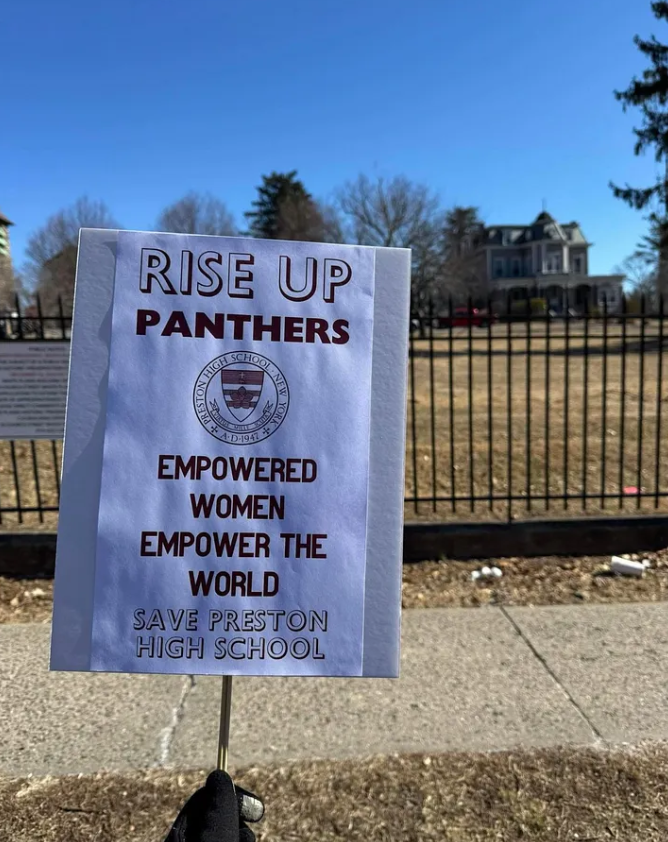
So can you imagine, how the announcement of the closing of Preston High School and the uncovering of the deceptive reasoning has stirred me?
It reminded me, in the middle of a personal fight I’m enduring to be able to speak out about literal injustice, that women screaming from the mountaintops is not that unique. It’s not exclusive to me, as some people are trying to make me feel. That, while I may not have gotten it from my family, or from society, or from church cultural, I got it from somewhere — I got it from Preston.
A place that truly empowers women to empower the world. We learned to take risks, think critically, actively participate in our community’s growth and development, be leaders, not back down on the path of ambition, prioritize self-expression, advocate, make friends with girls (whew!), be mentors, be role models, be confident, love our passions and fight for our world.
My forthcoming memoir delves deeper than my previous works, directly confronting the systems designed to keep women silent in harmful situations. These systems — whether embedded in romantic or familial relationships, churches, schools, or workplaces — operate with the same underlying mechanism: discouraging women from speaking truth to power.
I recognize that some of my recent writing has emerged as a response to negativity directed at me, pushing back against those who misunderstand or misrepresent my message. But I’ve come to realize that those who don’t get it likely never will. The energy spent in that defensive posture could be better channeled.
This defensive posture is also rooted in my natural tendency to write as a response to discomfort. When I feel misunderstood or challenged, my instinct is to reach for my pen rather than my voice. While this has served me well in many contexts, I recognize that constantly defending myself against those who antagonize me — the same who are perpetuating the very systems I aim to dismantle — depletes energy better spent elsewhere. I don’t expect universal agreement; if I did, I wouldn’t need to fight for justice in the first place. But there’s a difference between fighting against and fighting for. It’s time to lock in on the latter.
Fighting for is the more important work — the work I’m now recommitting to — empowering women through storytelling that ignites transformation. By continuing to share my journey, I hope to illuminate pathways for others to find their voices. My personal narrative isn’t meant to center myself (although it does, I’m not naive to that). Still, it’s most importantly meant to serve as a blueprint for navigating instances and institutions that weren’t shaped with women’s voices, respect or power in mind.
This is what Preston taught, and is teaching, me — that our individual stories, when shared with intention, become collective power. That empowered women truly do empower the world. Not just through inspiration, but through concrete actions that challenge and change the things going wrong around them.
Beyond the pages of my coming memoir, I envision continuing to create content that explores the complexities of motherhood, offering cultural commentary that challenges prevailing narratives in music, television, and other modes of entertainment, providing Biblical analysis from a Black woman’s perspective that has been historically marginalized in theological spaces (so grateful that this is slowly changing!), and yes, continuing to share the relationship advice that first connected me with my readers. I might even give yall some tips on how to use AI, just because I really do write about my expertise and that is becoming it. 🤣Each of these writing paths represents another facet of empowerment — another way to ensure that women’s experiences are centered rather than silenced, celebrated rather than suppressed.
This is the fight I’ve been preparing for — the one Preston helped shape in me. It’s homecoming y’all — time to celebrate, as my second favorite Disney movie Mulan would say, “A girl worth fighting for!”