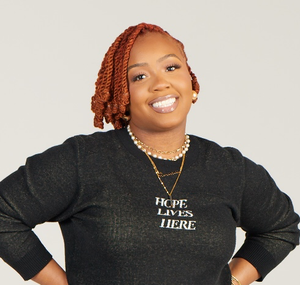
The Gospel According to Tobe Nwigwe: What One Song Said That the Church Wouldn't
WATCH THIS for context.
Tobe Nwigwe is a Grammy-nominated rapper, singer, actor, husband to Fat Nwigwe (also a rapper), and father of five. Since 2016, he’s been posting original songs on social media, known for poetic lyricism, visual storytelling, and inspirational — sometimes spiritual and Christian-based — messages.
Raised Catholic, Tobe now attends non-denominational churches. Though a Christian, he’s not a “Christian rapper,” as his music spans a wide range of topics.
On September 18, he performed a sold-out, one-night-only concert at the Kennedy Center in Washington, D.C., accompanied by the National Symphony Orchestra. The event marked the release of his highly anticipated album, Hood Hymns, featuring a curated selection of his fan-favorite songs.
If you’ve never listened to Tobe, here are some of his lyrics that I gathered from the top of his Instagram (1.6M) and YouTube (679K):
“Try Jesus, not me, cause I throw hands.”
“Some of the most solid niggas I know stood 10 toes down on sinking sand.”
“Wish I could help you understand having hoes ain’t living. Wish I could help you understand the importance of raising children.”
“Woe woe woe to you in the land of the living who leads the shepherd’s sheep astray.”
“Oh Lord how far does your love come down? My dawg caught a body, and he just ain’t been the same. If you touch him he will change, but he needs more of you.”
A clip of Tobe performing his music at the Kennedy Center, particularly the “All my niggas need Jesus” song clip went viral among the Black church world a few days ago, and I saw a lot of negative reactions.
Some statements I saw included things like “we take things too far,” “we ALL need Jesus,” and “it’s a no for me.”
Here’s my perspective:
Y’all niggas love eisegesis.
What’s Eisegesis
Eisegesis (wrong) is interpreting a text, especially Scripture, by inserting personal ideas, biases, or agendas. It’s the opposite of exegesis (right), which means to “draw out” meaning based on the text’s context, background, and history (rather than insert your own).
A classic example is Philippians 4:13:
“I can do all things through Christ who strengthens me.”
Many use this verse to exclusively mean they can achieve any goal or relate it to personal success, but in context, Paul is talking about enduring hardship with contentment.
Back to Tobe
Similar to this video, y’all took this clip, and pulled it out of its context. Y’all took something happening in the world, and gave your opinions about it in light of the church. Tobe isn’t making music for y’all to sing on a Sunday morning during praise and worship. If he were, y’all would’ve known about him already, but you didn’t.
And since you didn’t, it wasn’t your place to critique his lyrics or his intent, especially when they aren’t written for you, your choir, or your pulpit.
You know whose business it was?
Tobe’s, who deposited that check.
The people who sold out the theater.
The National Symphony Orchestra and their pockets.
His listeners, followers, and subscribers.
And if you’re not any of those people, you could’ve kept scrolling after watching rather than adding negative commentary.
With that thought in mind, when was the last time your Gospel message went viral? When was the last time you uttered the name of Jesus and 505 THOUSAND people heard it?
I’m saying that to be funny, of course, but also to make the point that the good news of Jesus does not have to fit the mold that you’ve been shown Him in to reach the masses. Jesus said that if He be lifted up from the Earth (and was) that He would draw ALL men (and is). And, that includes men, and women, who use the word “nigga” colloquially and positively.
Let’s Reflect
The origin of the word nigger is the Latin word “niger” which means black, similarly to the Spanish and Portuguese word negro, which means black also. The colonizers and slavemasters TOOK the word (like they did everything else) from the 16th through 19th centuries and made it derogatory against the Africans captured during the trans-Atlantic slave trade and their descendants.
In the second half of the 20th century, Black Americans attempted to take the word back in the form of “nigga.” This reclaiming of language has been, and will continue to be, long debated about its appropriateness. Whether you believe we should continue to use the word “nigga” amongst ourselves, or not, it does not erase the fact that many well-intentioned people do, and will continue to.
In and out of music, Black people will continue to reference people we bond with and love as, “My nigga,” such as in 2016 when comedian Larry Wilmore referred to President Barack Obama at the White House Correspondents’ dinner. We’ll continue to start to indulge in a good story with enthusiasm with “Nigggaaaaaaa, let me tell you.” And, we’ll continue to refer to a bunch of Black people in any given room as “niggas.” Maybe you won’t, but others will, and the controversy will live on and so will the Every Nigga Deserves page. 🙌🏽👏🏽
This Debate
But this debate here rests in two things:
What we believe about the story and mission of Jesus?
What we believe about words?
What I Believe
What I believe about the story and mission of Jesus is that it’s meant to capture the hearts of all people. That is not to mean that everything is acceptable or a right way to bring people closer to him, but there are ways, outside of church buildings, for others to get the message of Jesus out, in a way we never would — and He can be received the same way.
This is also a reminder that all of the ways we use within church buildings are not always edifying, they don’t always land, and everyone is not always open to the same types of messages that we’ve gotten used to.
In Romans 10:14–15, Paul writes, “How, then, can they call on the one they have not believed in? And how can they believe in the one of whom they have not heard? And how can they hear without someone preaching to them? And how can anyone preach unless they are sent?”
How, then, can they call on the one they have not believed in? They can’t.
And how can they believe in the one of whom they have not heard? It doesn’t specify that they need to hear within a church building.
And how can they hear without someone preaching to them? It doesn’t specify that someone preaching to them needs to be a preacher, or ordained, or have any of the titles that we hold so dearly, as if we own them.
And how can anyone preach unless they are sent? It doesn’t specify where they’re sent to, only who they are sent from.
I believe Tobe is doing what the one who sent him called him to do, “Go and make disciples of ALL nations.”
What I believe about words is that they hold the meaning that we give them. It’s why I wrote IKIGAI, because “love” actually is not enough to describe what love is fully — it needs other words, more fabric, it needs depth that sometimes when we use it, we lack. I believe that words are only derogatory because someone wakes up one day and makes it derogatory. And, I believe that we have the power to reclaim and change words. And if a word, that is sometimes used positively, and within context, is being used as a tool to witness, I think, we should let Jesus be made known to those niggas.
And to everyone 👀 who says music is dead, y’all (ok I’m done saying it LOL) ain’t listening to the right music.